

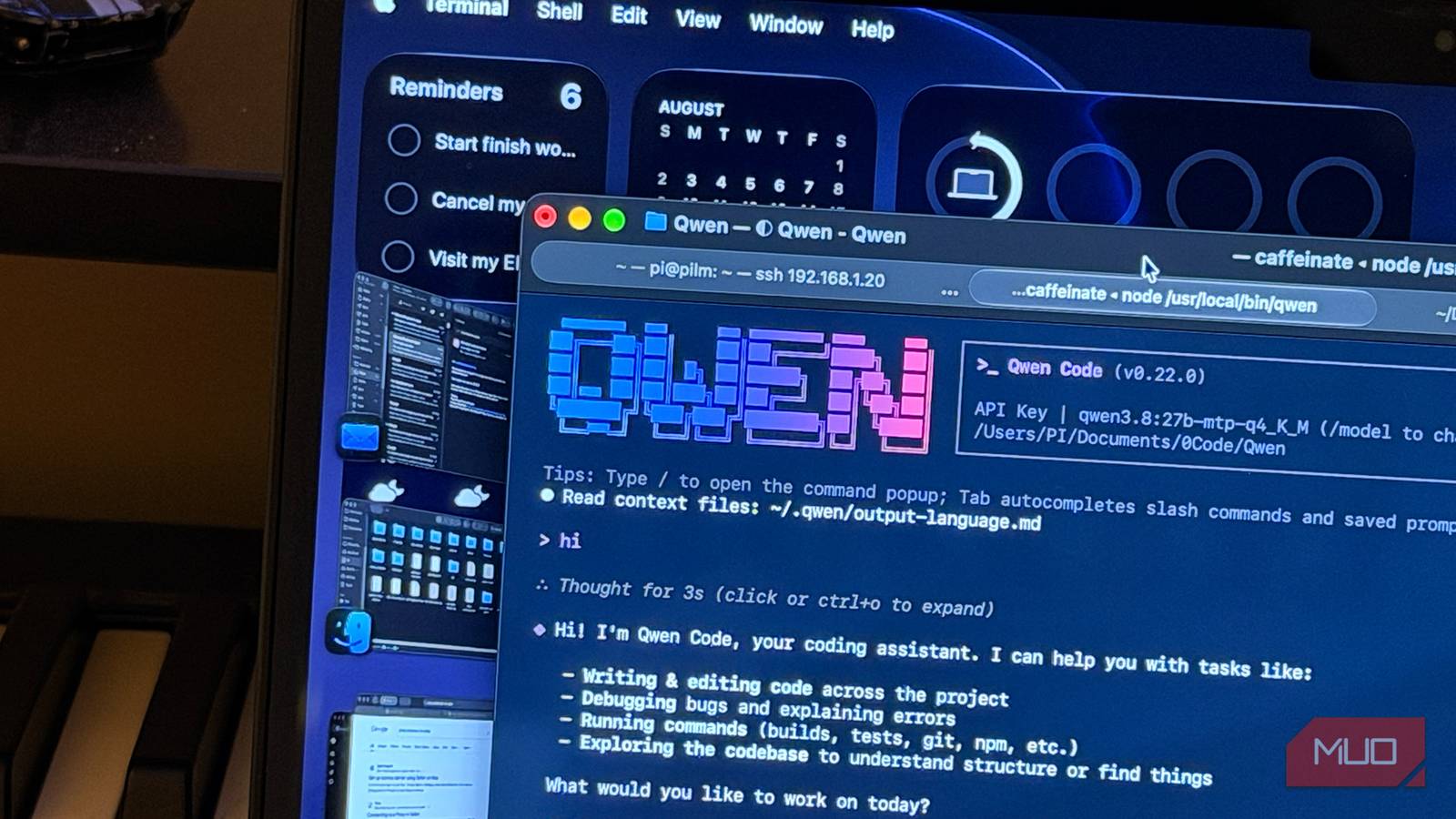

Being tied to Anthropic’s AI models and subscription plans is probably one of the most disappointing aspects of Claude Code! You end up paying quite a lot every month, even when you can’t access all models. But what if we no longer need Claude Code? What if you could bring the models you want into a more open coding agent? I’ve been testing one of the best replacements for Claude Code recently — Qwen Code — and it is more flexible than you imagine. The best part? It is completely free to use.
Qwen Code is a free harness that runs any model you want
The tool costs nothing, and the model is your call

Qwen Code is an open-source AI coding agent that can effectively replace Claude Code while offering better flexibility! You can access this coding agent through Terminal just as you do with Claude Code! However, you are not limited to Claude’s paid plans or API platforms. Instead, you can connect it and use it with almost every AI provider out there, including local AI tools. In short, Qwen Code is completely free, and you get to choose the model you work with.
It’s true that you can route Claude Code through other AI model providers, but that still doesn’t beat the flexibility I found with Qwen Code. With the former option, you lose all the good stuff about Claude Code and agentic coding. With Qwen Code, regardless of the model you use, you have access to these core features. The best performance will indeed be from Qwen models because the AI agentic tool is optimized for them.
Yet, you can use one of the many ways to access these Qwen models! It could be something that the tool recommends or via OpenRouter. In the same way, if you decided to use the latest coding models from OpenAI or Anthropic, Qwen Code can get it working for you.
Getting it running and picking a model that costs nothing
Multiple configuration options and a model that just worked
Setting up Qwen Code on my Mac was easier than I expected. I used a curl script, and the installation took a few seconds. The first screen I saw when I opened Qwen Code for the first time was the authentication screen, which offered three options: Alibaba Cloud, a third-party provider, and a custom provider. While the second option lets me go with something like OpenRouter, I could have set up an offline system like Ollama using the third method.
For this testing instance, I used the third-party provider option and configured the DeepSeek API Key. I’ve tried routing Claude Code through the low-cost, high-performance AI model before and wanted to do the same with Qwen Code. I completed the setup in a second because I just had to paste the DeepSeek API key. To understand how it works with free models, I also tried configuring Qwen Code with my OpenRouter account to try a couple of free models.
I also love the option to run the /auth command and reconfigure the model options whenever I want. Given that Claude Code doesn’t officially allow any other AI provider, this flexibility is miles ahead. Once you have configured the right models for your requirements, you can start using Qwen Code to build. However, after testing a couple of models, I can also assure you that the model matters as much as the tool.
Since the configuration, however, I’ve been trying quite a few things with Qwen Code!
Putting Qwen Code to real work across categories
It does deliver on most fronts
Something I noticed very clearly was that the performance depended on the model I was using. With DeepSeek, for instance, Qwen Code was exceptionally fast. However, I could not see such results with other models, especially free options. Now, as coding agents, there are more similarities between Qwen Code and Claude Code than there are differences.
Qwen Code checks almost all the boxes for coding experience, including subagents, hooks, skills, MCP support, plan mode, sandbox, and even computer use. If you do not want to use it in the terminal, you can also set it up as an IDE plugin with VS Code, JetBrains, or Zed. The team behind Qwen Code regularly releases updates and continues to add new features to the package.
I have also tested a couple of other features, such as the shared session mode, which lets multiple clients access a single agent session. Similarly, the Agent Arena function works great because it lets you run a task across multiple models to improve performance. Other features built into Qwen Code include its Instant Messaging channel bots and dedicated desktop app. Overall, I think Qwen Code can deliver on most fronts if you are expecting an experience comparable to that from Claude Code!
Where Claude Code still wins, and why I kept both installed
Well, I’m really impressed by what Qwen Code offers, and that it is completely free to use. Yet, there are areas where Claude Code wins. We should keep in mind that Claude Code is a more mature coding platform and that many of its features are more stable. On the other hand, Qwen Code places several of these features in the experimental category, which means performance may not be up to the mark. Nevertheless, the freedom to use almost any model you want is something we should all appreciate, and I’m sure Qwen Code is just getting started.
